
AdEx Partners News, Services
When AI Takes Action, Autonomy Becomes a Management Imperative
How SAP Autonomous Enterprise Is Changing Companies – and the Decisions That Now Belong on the C-Suite Agenda
SAP Autonomous Enterprise turns a technology topic into a question of how the enterprise is managed. Once AI agents take on tasks within business processes, prepare decisions, and trigger actions, companies need to redefine where autonomy adds value – and where clear boundaries, accountability, and human oversight must remain in place.
This puts a new question on the C-suite agenda: What work can meaningfully be delegated to AI – and what conditions must be in place for this to work securely, economically, and at scale?
In our conversation with Partners Jana Moser and Dr. Sven Pfeuffer, we explore what this shift means for companies in practical terms, where the most promising entry points lie, and why business value, architecture, governance, and commercials need to be considered together from the outset.
SAP Autonomous Enterprise in Brief
SAP Autonomous Enterprise is SAP's target image for a more agentic controlled enterprise software: AI Agents take on defined tasks within business processes, access data and systems, and execute actions within clearly defined rules and approval frameworks. This moves SAP Business AI beyond assistance toward controlled execution.
Expert interview with Jana Moser and Sven Pfeuffer
What Does SAP Autonomous Enterprise Mean for Companies in Practical Terms?
Sven Pfeuffer:
From a technology perspective, we are moving from assistance to execution. Until now, AI has primarily supported people by providing information, answering questions, making recommendations, or preparing decisions. With Autonomous Enterprise, SAP is taking the next step. Within defined boundaries, AI agents can plan tasks, access data and systems, and execute specific process steps. We are no longer talking only about a more capable copilot, but about an entirely new role for AI in business processes.
Jana Moser:
And from a business perspective, that is the critical difference. Until now, people have largely remained responsible for managing and executing a process, with AI supporting them. Going forward, some of that work can actually be delegated to digital agents. People define the objectives, rules, and boundaries and step in when judgment, approvals, or exceptions are required. This changes the management question: It is no longer simply about how AI can support employees, but about what work a company is prepared to delegate to AI - and what accountability must remain with people.
SAP Autonomous Enterprise therefore represents less a single new product than a new way for people, AI agents, processes, and systems to work together. It is precisely this interaction that makes the topic strategically relevant for companies.
Why Is Autonomous Enterprise a C-Suite Issue Rather Than Just an IT Topic?
Jana Moser:
Because the key questions cannot be answered within a single function. The COO looks at processes and which decisions can be automated. The CFO focuses on business value and cost. The CIO considers architecture, integration, and security. And the CHRO needs to understand how roles and collaboration will change. These questions and decisions are directly connected and therefore require a shared vision.
Sven Pfeuffer:
Exactly. A technically attractive use case is not enough. If data, permissions, architecture, or governance have not been addressed, even the most compelling use case cannot scale effectively. Conversely, a technically sound solution delivers little value if the business case is unclear or ongoing costs are not transparent. Autonomous Enterprise becomes a management responsibility wherever technical feasibility, economic value, and responsible autonomy need to come together.
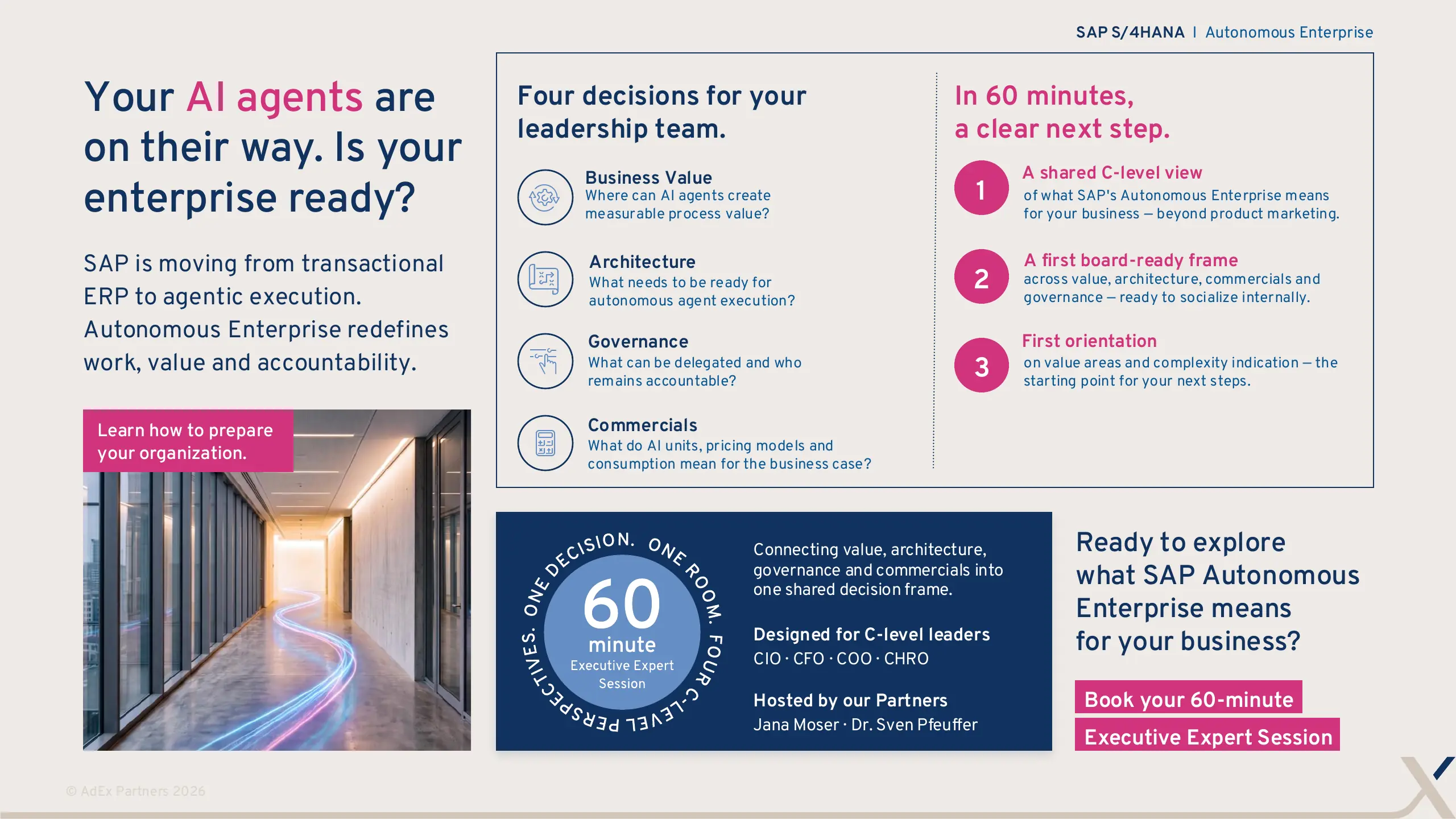
That is why, in our view, four dimensions belong on a shared management agenda: Business Value, Architecture, Governance, and Commercials.
Sven, What Exactly Do These Four Dimensions Cover?
Business Value is about measurable process impact. Architecture addresses the technical prerequisites for secure execution. Governance defines what an agent is permitted to do and who remains accountable. Commercials addresses what usage and scaling will actually cost.
The key point is that a strong use case must create value, be technically feasible, remain controllable, and make economic sense.
Where Should Companies Start with AI Agents?
Jana Moser:
Start with the business problem – not the technology. The key question is: “What outcome do we want to improve?” That might mean shorter cycle times, fewer manual handoffs, better cash conversion, or higher service quality.
Sven Pfeuffer:
The next step is to assess feasibility. Is the value measurable? Are the processes and data sufficiently prepared? Is it clear what the agent may execute autonomously and where a person needs to decide? And is the required capability already available? These questions make it possible to identify relatively quickly which use cases are truly suitable as a starting point. Companies also need to determine whether an assistant or agent for the use case is already available within the software solution or whether they will need to develop one themselves.
Jana Moser:
That is why our principle is: Start with the outcome, not with the agent. A strong first use case combines measurable business value with sufficient readiness and clear accountability.
Where Are Companies Still Falling Short on Autonomous Enterprise?
Jana Moser:
In my experience, the biggest gap is accountability. The more tasks an agent takes on, the more clearly companies need to define who sets the rules, which decisions may be delegated, and when a person must intervene. Autonomy does not mean giving up accountability.
Sven Pfeuffer:
That is precisely why governance is also changing. With conventional AI, the focus is often on whether an output is accurate and compliant. With agents, we also need to control what they are allowed to do, which systems they can access, and how their actions can be traced or stopped. Governance therefore expands beyond monitoring models and outputs to include identities, permissions, and real-world actions.
Our guiding principle is: “Execution can be delegated. Accountability cannot.”
Alongside Governance, Economics Also Plays a Central Role. What Is Changing?
Sven Pfeuffer:
The cost structure is becoming more complex as well. Autonomous Enterprise introduces increasingly usage-based models. AI Units, Premium AI, and platform and integration costs can cause expenses to rise with actual usage. Before scaling, companies therefore need a clear understanding of what it costs to operate an agent and how those costs will develop over time.
Jana Moser:
That is exactly why business value and cost need to be considered together. Once it is clear which process outcome an agent improves, companies can determine whether its use makes economic sense. The decisive factor is not the price of a single AI interaction, but the cost and value contribution per process outcome.
If AI Will No Longer Just Assist but Also Act, What Decision Does the C-Suite Need to Make Now?
Jana Moser:
At its core, this is about making a deliberate decision regarding what work a company wants to delegate to AI and where human judgment and accountability must remain. This is not merely a technology question; it is a decision about how work and processes will be designed in the future.
Sven Pfeuffer:
Four perspectives need to come together: Where is business value created? What is technically possible? What governance is required? And under what economic conditions does implementation make sense? Only by considering all four together can companies determine where autonomous execution is truly valuable and scalable.
What Does SAP Autonomous Enterprise Mean for Your Company?
In our 60-minute Executive Expert Session „From AI Assistants to the Autonomous Enterprise“ Jana Moser and Dr. Sven Pfeuffer will work with you to assess your company’s specific starting point.
The session focuses on the same four perspectives that shape this interview: Business Value, Architecture, Governance and Commercials. Together, we explore the most relevant use cases, which prerequisites are already in place, and which decisions should come next for your company.
In just 60 minutes, you will gain a shared C-suite perspective on opportunities, open questions, and practical next steps.
→ Request an Executive Expert Session