
AdEx Partners News, Services
How AI-native is your organization? Self-assessment for decision-makers
How far along is your organization on the path to true AI-nativity? The self-assessment provides a well-founded initial status assessment.
Whether an organization uses AI is hardly the crucial question anymore today. The crucial factor is whether AI is already beginning to structurally change value creation, delivery, and decision-making logic. Exactly there lies the boundary between AI usage and AI nativity. Recently book published by Haufe „AI-native consulting“ describe our partners Stephan Weber, Daniel Ehmann and Stefan Schmautz this change as a structural transformation issue.
The focus is on Business model, operating model, culture, and technology and data foundation. The book is designed as a practical compass for consultants and client-side executives seeking guidance in an increasingly complex AI reality.
This results in a very specific question:
How AI-native is your organization really today, and what follows from that for the next steps?
This article offers a compact self-assessment to classify your current maturity level and potential next development steps.
Why the topic is relevant now
The current AI debate is still frequently focused on tools, pilots, and short-term productivity effects. However, this falls short for consulting organizations. The book makes it clear that the actual shift lies deeper: AI is changing how value is created, how decisions are prepared, and how consulting must be organized.
From a market perspective, too, the timing is relevant, because the actual disruption of the consulting industry is taking place now, especially since Generative AI is shifting the benchmark significantly toward integrated value creation.
For CIOs, CTOs, and IT leaders, this makes a new evaluation question central: Does a consulting partner's use of AI go beyond individual tools? Or is a reliable model of delivery, governance, knowledge transfer, scalability, and trust already emerging?
AI Usage and AI Nativity: The Crucial Difference
Many organizations have already taken initial, meaningful steps to use AI to support research, analysis, drafting text, or proposal work. As a starting point, that is quite helpful.
True AI-nativity, however, begins at a different point: when AI becomes part of the value creation logic, so that processes, roles, decisions, knowledge models, and leadership logics evolve.
What characterizes an AI-native organization
An AI-native organization can be identified by several characteristics:
- AI is embedded in strategy, delivery, and value creation.
- Knowledge is transferred into reusable assets, playbooks, and governed IP.
- Delivery is evolving toward senior-led, AI-augmented teams with clear quality and validation steps.
- Governance, transparency, data protection, and human validation will become part of the value proposition.
- Role profiles, skills, and career paths are being further developed.
- Pricing and performance models are moving more toward value contribution, reusability, and outcome.
Especially for regulated and complex environments, this level of maturity is crucial. Because there, customers expect not only speed, but above all reliable execution, clear guardrails, and advice they can trust. That is, at its core, Trusted Advisory at its best.
Transparency is essential for assessing your current position: What is the current maturity level of your organization regarding AI-nativeness? Where do you stand, and what are the appropriate next steps for you?
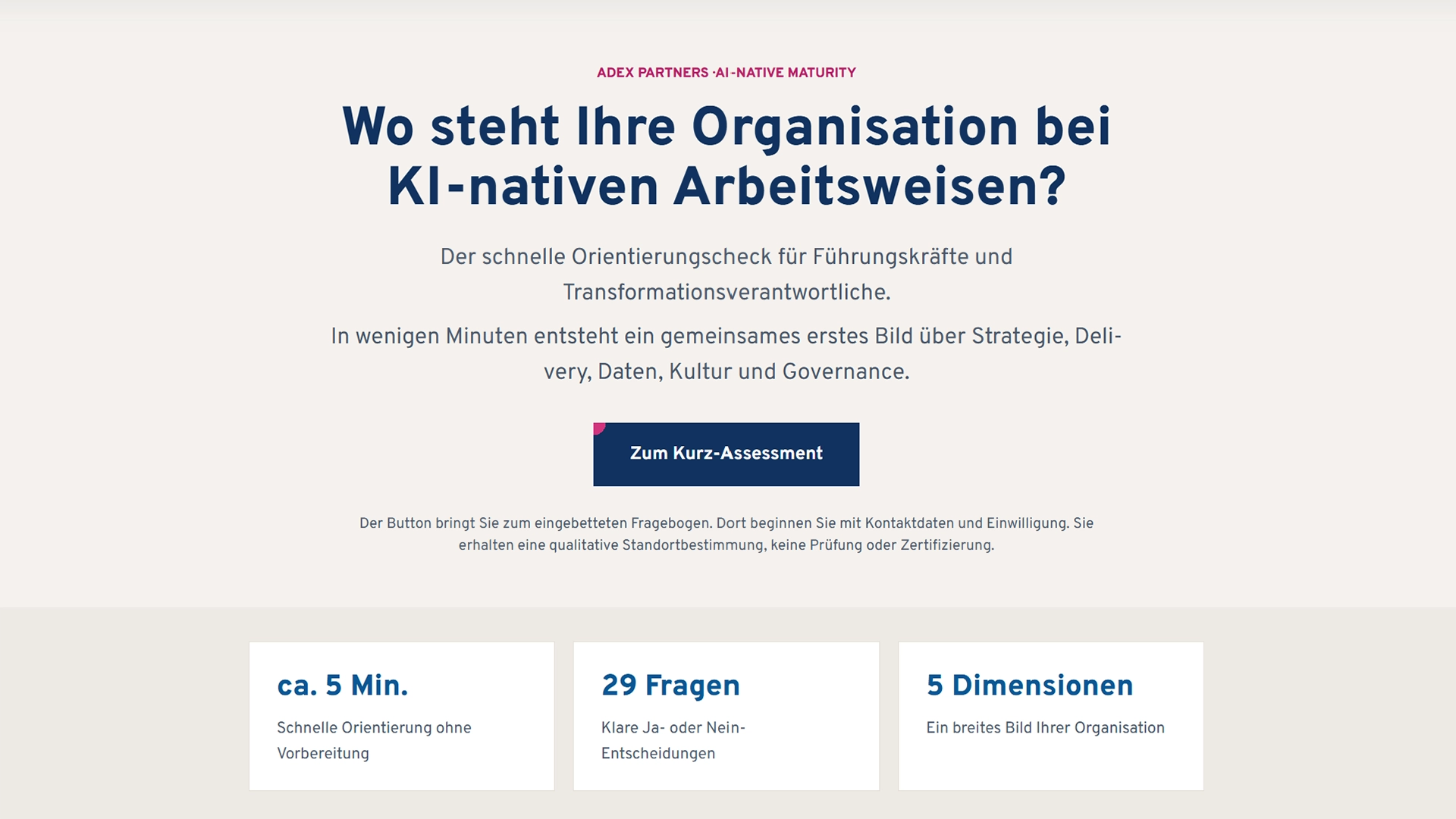
To determine precisely that, we have a free self-assessment developed to enable you to perform an individual assessment in the relevant dimensions within just a few minutes. On this basis, you will receive a qualitative evaluation for each dimension and concrete starting points for the next stages of development.
Conclusion
The question of AI-nativity is not decided by individual tools, but by how consistently a consulting organization further develops value creation, delivery, governance, knowledge, and operating model. Exactly therein lies the true level of maturity: in the ability to effectively translate AI into the organization, make expertise scalable, and purposefully combine human judgment, responsibility, and trust with technological capabilities.
For decision-makers, this means one thing above all: realistically assessing their own position and deriving the right priorities from it. Because the path to an AI-native organization does not begin with maximum technology, but with the right structural decisions.
From our perspective, this creates a very concrete need for action: to understand AI as a transformative issue for strategy, delivery, governance, and value creation, and to translate that understanding into robust, step-by-step implementation in precisely those areas.