
Why maturity assessments are often conducted too benignly
Many organizations already have governance documents, data stewards, architectural principles, platforms and reporting standards. All of this is important – but it doesn't yet prove that the organization is data-capable.
A real maturity assessment doesn't ask if artefacts exist. It asks if the system works in everyday life. Are responsibilities truly effective? Are data quality issues systematically resolved? Can business units access reliable data? Are decisions actually based on the same metrics?
If governance consists solely of policies, boards, and slide decks, but conflicts over definitions, responsibilities, and priorities remain unresolved, there is no maturity – only documentation.
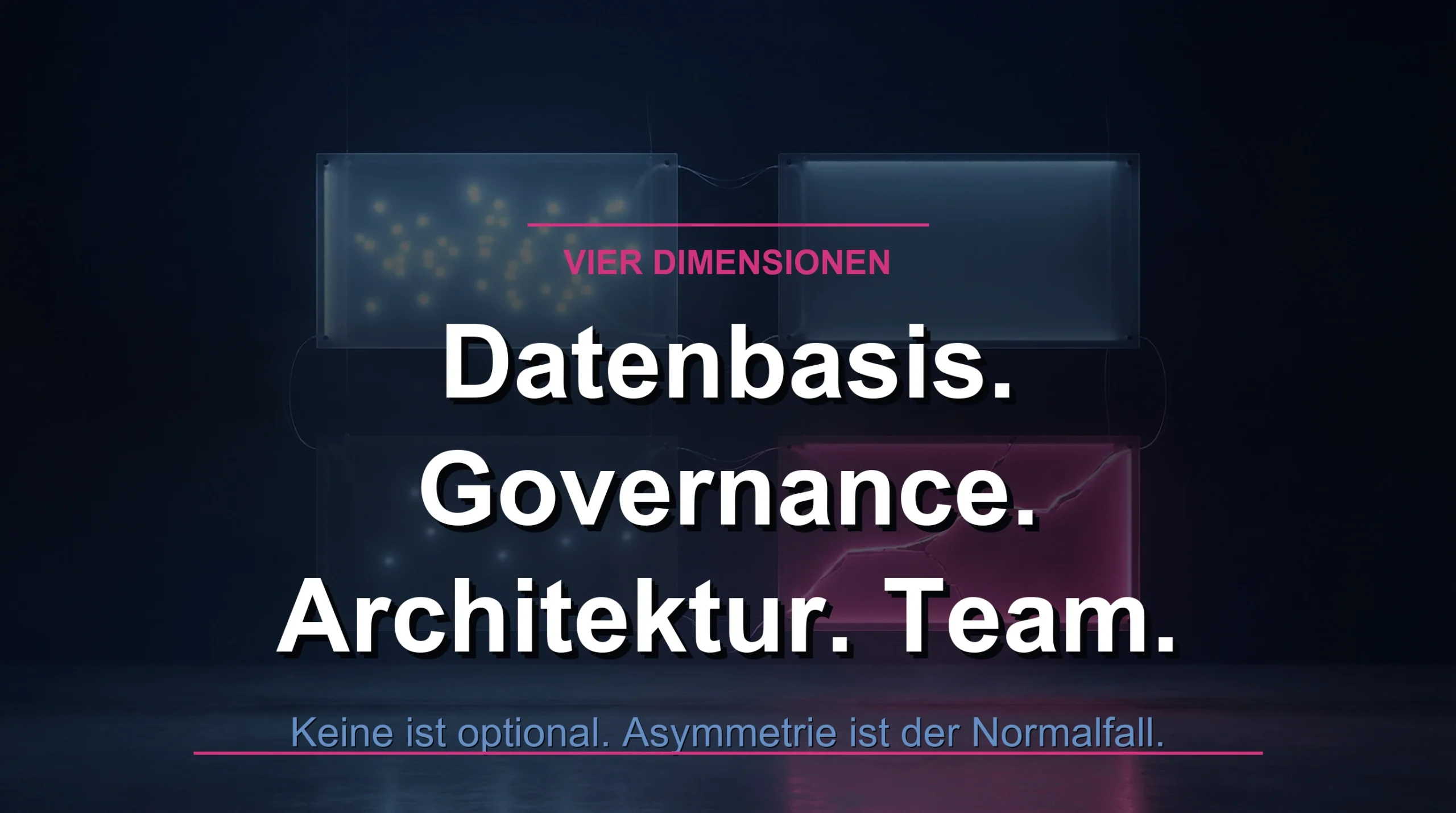
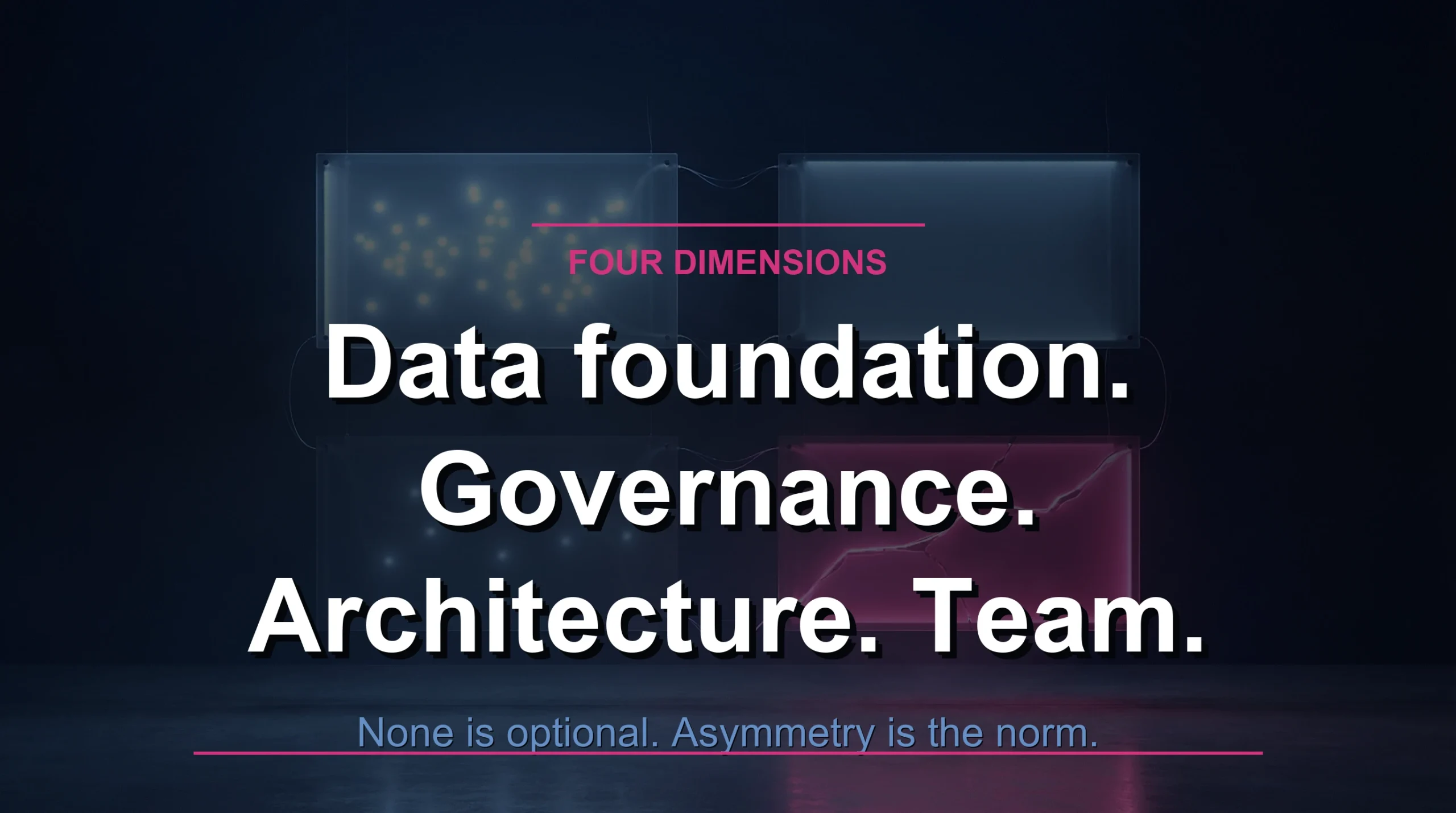
Four areas that must be assessed honestly
Database
How reliable, available, and connectable is the relevant data actually? Not theoretically, but for the prioritised decisions.
Governance & Ownership
Are roles, responsibilities and escalation paths clear enough for quality, access and prioritization to be effectively managed? The crucial point is not whether these roles are defined, but whether they are actively practised and bring about results in daily operations. Since DORA has classified data as a „critical or important function“, this also includes robust exit planning and portability testing for regulated companies.
Architecture & Tooling
Do platforms, integrations, and operating models drive the desired development – or do they create friction, dependencies, and bespoke local solutions?
Operating Model & Team
Are there the capabilities, rituals, and decision-making pathways to effectively run data initiatives beyond project launch?
A realistic picture only emerges when these four fields are considered together. This is because most problems are not purely technological. They arise at the interfaces: between business departments and IT, between data responsibility and platform operation, and between strategy and delivery.
Those aiming for increasingly composable architectures in 2026 need governance as a prerequisite, not an afterthought: Without clear API governance and master data ownership, integration sprawl will emerge instead of true composability.
What an honest look at maturity often reveals
In practice, an asymmetrical picture often emerges. Some organizations have invested in architecture but have not developed their governance accordingly. Others have strong ownership models but a data foundation that is not robust enough. Still others are very advanced in individual areas – but not in the capabilities that would be truly crucial for prioritized business decisions.
In multi-provider environments, another gap becomes apparent: many organizations can migrate workloads but cannot credibly exit a provider relationship. Data gravity and the absence of cross-supplier playbooks quickly render exit plans toothless.
That is precisely why maturity is not an academic scale. It is a decision-making tool. It shows where ambitions are supported by real prerequisites – and where they are not.

The most common management mistake: deriving a roadmap directly from ambition.
If the starting point is overestimated, the roadmap will also be wrong. Companies then end up with programs focused on data products, AI or self-service analytics, even though central foundations are still unstable. Not every ambition is wrong. But every ambition needs a robust sequence.
An honest assessment of maturity precisely protects against this. It creates the foundation for realistic decisions: What is possible in the short term? What requires groundwork first? Where is a pilot sensible? And where would speed just be expensive idling?
How AdEx Partners leverages this step
We do not use the maturity assessment as a general assessment without consequence. We link it to the target state from Step 1. Therefore, it is not an abstract assessment of the company's „data maturity“, but rather its ability to actually support the prioritized decisions and initiatives.
This does not create a generic traffic light system, but a robust gap analysis. This gap analysis is the bridge to the roadmap: What prerequisites need to be created? Which topics can run in parallel? And where is deliberate restraint worthwhile?
An honest assessment of maturity is uncomfortable – but productive.
- Overview
- Step 1: Aligning with business goals
- Step 2: Honestly assess maturity
- Step 3: Roadmap with clear priorities