
Data strategy is not a theoretical paper. It is a capital allocation decision.
Anyone investing in data, analytics, or AI today is not investing in neutral infrastructure. They are investing in priorities. In ownership. In speed. In the question of which decisions should be made better, faster, and more reliably in the future.
That is precisely where the problem begins: many companies start data programs with the right impulse – but without a shared vision. Then reporting initiatives, governance projects, platform decisions, data products, and AI pilots are created in parallel. Each measure makes sense on its own. Together, however, they still do not add up to a management system.
One department is demanding better transparency. Another wants to make AI productive. IT is modernizing the platform. Governance is building policies. And after twelve months, there is more activity, but no more decision-making power. That is not an execution problem. That is a strategy problem.
Why a clean data strategy is needed right now
Current pressure is higher than it was just a few years ago. AI is raising expectations for data quality and availability. Cost reduction programs are increasing the pressure to deliver measurable value. At the same time, regulatory requirements are rising, and many organizations are still operating with fragmented data landscapes, unclear responsibilities, and legacy reporting structures.
Two developments are specifically compounding this pressure: SAP ERP 6.0 reaches the end of maintenance at the end of 2027 – anyone without a robust data architecture by then will be migrating blindly. And since January 2025, DORA has been in effect: for regulated companies, data governance is therefore no longer an optional maturity topic, but a regulatory requirement.
Without a data strategy, companies react to this pressure with actionism. With one, they make deliberate decisions: Where is it worth investing first? Which prerequisites are truly missing? Which initiatives contribute to the same goals – and which ones distract from them?

The three questions every robust strategy must answer
What should data initiatives contribute to anyway?
Not every data initiative deserves a budget. First, it must be clear which business goals are truly to be supported – growth, margin, cash, service level, risk, or transformation speed.
How well-positioned is the organization actually today?
There is often a big difference between documentation and actual capability. Maturity does not mean: Guidelines exist. Maturity means: The system sustains decisions and execution in everyday operations.
What needs to happen first – and what should deliberately happen later?
A roadmap is not a wish list. It is the order in which scarce resources are deployed so that early impact and later scaling work together.

What a data strategy must achieve to truly steer
A robust data strategy does not explain methods—it makes decisions. It treats data, analytics, and AI not as an abstract discipline, but as a management logic under real pressure: too many initiatives, too little clarity, too few visible trade-offs.
Four points determine whether a data program truly becomes a management tool:
- Less generic strategy language, more consequences for management
- Less methodological talk, more prioritization and clarity of goals
- Less tool or platform discussion, more decision-making system
- Clear reference to governance, operating model, and execution capability
How the series is structured
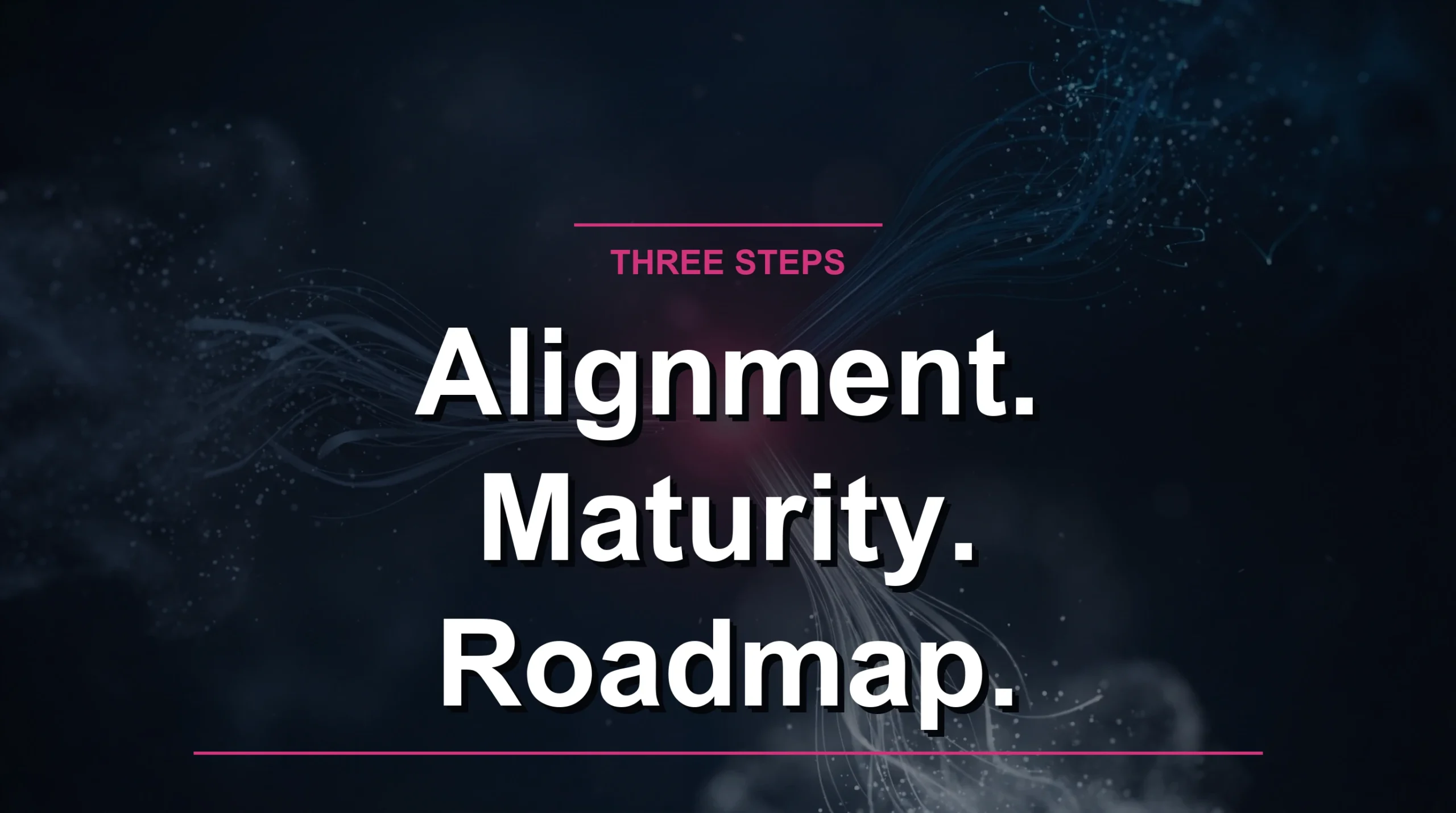
In the following three steps, we will tackle one central decision at a time. First: Which data initiatives even deserve resources? Second: How honest is one's own starting picture? Third: How do you build a roadmap that doesn't end with slides, but makes priorities visible?
That is precisely the difference between a data program that generates activity and a data strategy that unleashes business impact.